
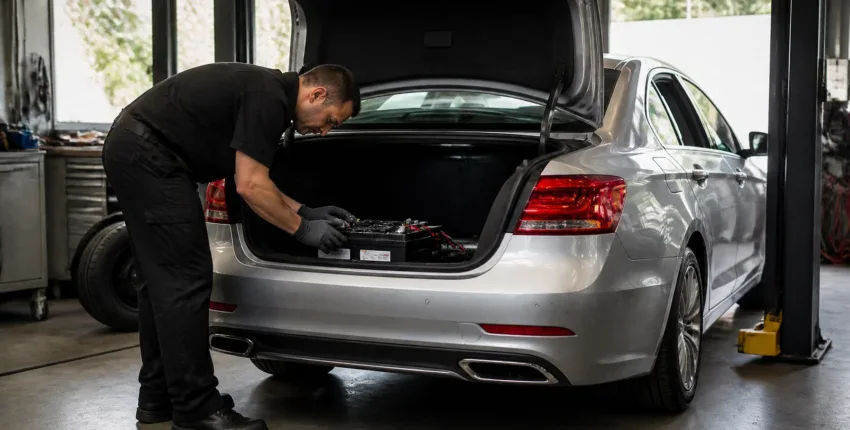
A BMW battery is more than a component that starts the engine. It supports the vehicle’s control modules, lighting, comfort systems, safety features, and onboard computers. When battery health begins to decline, the symptoms may appear as small electrical glitches before the car eventually refuses to start.
For Vancouver BMW owners, replacing a battery does not necessarily mean paying dealership prices. A qualified independent shop can test the battery, install the correct replacement, and complete the required BMW battery registration. The important point is choosing a BMW specialist that understands both the physical installation and the electronic programming that follows it.
Signs Your BMW Battery May Need Replacing
BMW batteries can weaken gradually, although some fail with very little warning. Pay attention to changes in the way your vehicle starts and behaves.
Common warning signs include:
- A slower or extended crank when starting
- Clicking sounds instead of a normal engine start
- Dimming or flickering interior and exterior lights
- “Increased battery discharge” or similar dashboard warnings
- iDrive, radio, or instrument display resets
- Power windows, seat controls, or other accessories operating slowly
- An automatic start-stop system that becomes unavailable
- Needing repeated jump starts
- Corrosion, swelling, or physical damage around the battery
A single symptom does not always prove that the battery is at fault. The alternator, charging system, battery cables, and parasitic electrical drains can create similar problems. That is why proper testing is more useful than replacing parts based on guesswork.
A battery that is several years old and showing borderline test results deserves particular attention. Vancouver’s frequent short trips, traffic, wet weather, heated seats, windshield defoggers, and other electrical demands can place additional strain on a battery that is already losing capacity.
BMW Battery Replacement Is Not Just a Simple Swap
On an older vehicle, battery replacement may involve removing the old battery, installing a new one, and reconnecting the terminals. Many modern BMWs require an additional electronic step: the new battery must be registered with the vehicle’s energy management system.
The system uses the Intelligent Battery Sensor, commonly called the IBS, to monitor information such as battery voltage, current flow, temperature, and state of charge. The vehicle uses this data to control how the alternator charges the battery and how electrical functions are managed when battery power is limited.
When a new battery is installed, the BMW needs to know that the battery has changed. Registration updates the vehicle’s battery history and allows its charging strategy to match the new battery’s condition and specifications.
This process is often described as an IBS reset or battery adaptation reset. Technically, the IBS sensor itself is not necessarily being replaced or “reset” as a standalone part. Rather, a BMW-capable diagnostic system registers the new battery and resets the related energy-management values that the IBS reports to the vehicle.
For most modern BMWs, battery registration should be treated as an essential part of replacement: not an optional extra.
Why Battery Registration Matters for Battery Life
A BMW’s charging system is designed to adjust its operation based on battery age, capacity, and type. If the vehicle still believes that an old battery is installed, it may not charge the replacement correctly.
Failing to register the new battery can contribute to:
- Overcharging or undercharging
- Premature battery wear
- Repeated battery-discharge warnings
- Unusual electrical behaviour
- Reduced reliability during cold starts
- Shorter service life for an expensive new battery
Registration is especially important if the replacement battery has a different capacity or technology than the original. The vehicle may also require coding or programming to reflect a change from a conventional battery to an AGM battery.
A battery that is physically compatible may still be electronically incorrect for the BMW. The right replacement must match the vehicle’s requirements, and the car’s energy management system must be updated accordingly.
AGM vs Conventional BMW Batteries
BMWs commonly use either conventional flooded lead-acid batteries or AGM batteries. The correct choice depends on the model, year, equipment level, and the battery originally specified for the vehicle.
AGM batteries
AGM stands for Absorbent Glass Mat. These batteries are designed to handle higher electrical demands and repeated charge-and-discharge cycles. They are commonly found in BMWs equipped with automatic start-stop systems or extensive electrical equipment.
AGM batteries offer several advantages:
- Better resistance to vibration
- Stronger performance under heavy electrical loads
- Improved ability to handle frequent cycling
- Suitable operation in vehicles with advanced energy management systems
They are typically more expensive than conventional batteries, but using the correct AGM battery can be important for reliability and long-term performance.
Conventional batteries
Traditional flooded lead-acid batteries are still used in some older or less heavily equipped BMW models. They can be an appropriate replacement when they match the vehicle’s original specifications.
However, a conventional battery should not automatically be used as a lower-cost substitute for an AGM battery. Downgrading the battery type without updating the vehicle’s programming can result in incorrect charging behaviour and reduced battery life.
In some cases, an older BMW can be upgraded from a conventional battery to AGM. That decision should be based on the vehicle’s electrical configuration, battery capacity, and coding requirements: not price alone.
A BMW mechanic should confirm the correct battery type and amp-hour rating using the vehicle’s existing battery information, model details, and VIN when necessary.
Why Dealership Battery Prices Can Be Higher
BMW dealerships provide valuable expertise, but their pricing structure is usually different from that of an independent specialist. A dealership battery replacement may include higher facility costs, manufacturer-branded parts pricing, standardized labour rates, and diagnostic charges built around the dealership service model.
The battery itself may also be sold through a more expensive retail channel. In addition, owners may be quoted for a specific OEM-branded battery even when a high-quality BMW-compatible replacement would meet the vehicle’s requirements.
That does not mean every dealership quote is unreasonable or that every independent shop offers the same quality. The real issue is whether the lower-priced alternative includes the complete service:
- Battery and charging-system testing
- Correct AGM or conventional battery selection
- Safe installation and terminal inspection
- BMW battery registration
- IBS or energy-management adaptation reset
- Verification that the alternator and electrical system are operating properly
A low quote that excludes registration or uses the wrong battery specification is not a genuine saving. It may simply move the cost into a premature failure or a later electrical diagnosis.
A Cost-Effective Alternative for Vancouver BMW Owners
MADA Autosport provides BMW-focused service for drivers who want dealership-quality knowledge without automatically paying dealership-level prices. Our BMW-trained technicians bring more than 20 years of exclusive BMW experience to both mechanical and electronic repairs.
Battery replacement is handled as part of a broader diagnosis. Before recommending a replacement, we can check whether the battery is actually failing or whether the problem involves the alternator, IBS, wiring, or a parasitic drain. This helps prevent unnecessary parts replacement and gives you a clearer understanding of the repair.
Our BMW service and maintenance in Vancouver includes battery and electrical checks, while our electrical diagnosis service is available when warning messages or intermittent electrical problems require deeper investigation.
We use top-quality BMW-compatible parts and provide a one-year parts and labour warranty. Most importantly, we explain the work and pricing upfront, so you can make an informed decision before the repair begins.
What to Ask Before Booking Battery Service
When comparing a dealership with an independent BMW repair shop in Vancouver, ask a few direct questions:
- Will you test the battery and charging system first?
- Which battery type and capacity does my BMW require?
- Is the battery AGM or conventional?
- Will you register the new battery electronically?
- Does the service include the IBS or battery adaptation reset?
- Will you check for an alternator problem or parasitic drain?
- What warranty applies to the battery and labour?
A shop that works regularly on BMWs should be able to answer these questions clearly. Battery replacement is a relatively straightforward physical repair, but the diagnostic and registration steps require BMW-specific knowledge and suitable scan equipment.

Protect Your BMW Before a No-Start Situation
A weak battery can leave you stranded, but the consequences may extend beyond a single failed start. Low voltage can cause misleading warning lights, communication faults between control modules, and electrical behaviour that takes time to diagnose.
Replacing the battery at the right time: and registering it correctly: helps protect your BMW’s reliability, electronics, and long-term ownership value. It is a maintenance investment that can prevent a stressful breakdown and avoid paying for unrelated parts that were never the real problem.
If your BMW is showing battery warnings, starting slowly, or experiencing unexplained electrical glitches, contact MADA Autosport for professional BMW battery testing and replacement in Vancouver. Our team can identify the correct battery, complete the required BMW registration and IBS reset, and provide transparent recommendations without unnecessary dealership pricing.
Book your appointment through our BMW repair services in Vancouver or call 778-488-0888 to discuss your BMW’s battery and electrical concerns.